
When you return to judo after 40, the ukemi (breakfalls) are the first thing to work on again, before techniques, before randori, before anything else.
The good news: muscle memory comes back fast if you’ve trained before.
The less good news: at this age, you can’t just fall the way you did at 14. The body is heavier, less flexible, and the hesitation that didn’t exist as a child settles in easily.
In this article, we’ll look at why breakfalls are the absolute priority when returning to judo, why they become scary after 40, a progressive method to relearn them calmly (from groundwork to standing falls), and the technical rules that actually make a difference.
In short:
I remember my first session back pretty well, and especially the moment the sensei called for ukemi.
A little apprehension. I let the judoka in judogi go first, because honestly I didn’t really remember the names of each fall anymore.
Back in my day, it was one by one, in a single file, so the sensei could watch and correct.
Today, in an adult class, it’s more everyone at their own pace. You line up at the edge of the mat and cross the dojo falling all together. Less spotlight, which works out fine when you’ve got 20 or 30 years of break behind you.
For me, the forward fall was a real revelation.
An incredible déjà-vu with the hand slap coming back on its own, the fluidity not quite there yet, but muscle memory at full capacity. And that’s exactly what comes up when I talk with the other 40+ at the club: breakfalls are both what you dread most when coming back, and what actually comes back the fastest.
Breakfalls come before everything else
No falls, no judo.
That’s why ukemi are the first thing you learn in judo, from the youngest age, before even thinking about throws. And when coming back, same logic: start there, before reworking your seoi-nage or throwing yourself into randori.
Talking with the members of my club who are in their forties, it’s actually the central challenge everyone brings up.
Someone who knows how to fall is someone who’s comfortable everywhere else:
- With techniques, because you can practice them all the way through without tensing up your partner.
- In randori, because you don’t spend the whole fight dreading the throw.
Falling badly or avoiding falls means limiting yourself on everything else afterwards.
At 40+, there’s also a physical factor you can’t ignore.
Most returning judoka, myself first, are heavier than in their teens and have lost flexibility. The impact on the ground isn’t the same, and neither is the tolerance for a bad fall.
A poorly executed move that was automatic at 15 can translate to a painful shoulder for two weeks at 44.
Ukemi are the foundation. Techniques, randori, and everything else in the practice are built on them.
Why fear sets in at this age
Past a certain age, apprehension settles in, and sometimes fear with it.
That’s really not the case when you learn young. Back in my day, we learned to fall at every training, it was part of the warm-up, an uncountable number of falls in all kinds of situations.
Nobody asked whether it was dangerous, we just did it.
At 40+, the reasoning is reversed.
You’ve spent 20 or 30 years avoiding falls in real life (stairs, ice, bikes).
The brain has integrated that falling is a problem.
And when you step onto a tatami and are asked to let yourself fall on purpose, it creates an internal conflict that didn’t exist as a child.
The real risk is that fear pushes you to resist. And if you resist a fully committed throw, that’s when you get hurt.
A fall that’s accepted and absorbed is at worst a bruise. A fall that’s refused, one you tense up against, can go as far as a dislocated shoulder or a serious sprain.
A body that resists absorbs the energy. A body that falls disperses it.
The good news for returning judoka is that muscle memory is an underrated resource. Automatic reflexes come back faster than you’d think for those who’ve practiced before.
You’re not starting from zero, even after 27 years.
For more on the origin of this fear, its mechanisms, and how to defuse it step by step, I cover all of that in the dedicated article: why falling feels scary after 40 (and how to get past it).
The method to relearn falling step by step
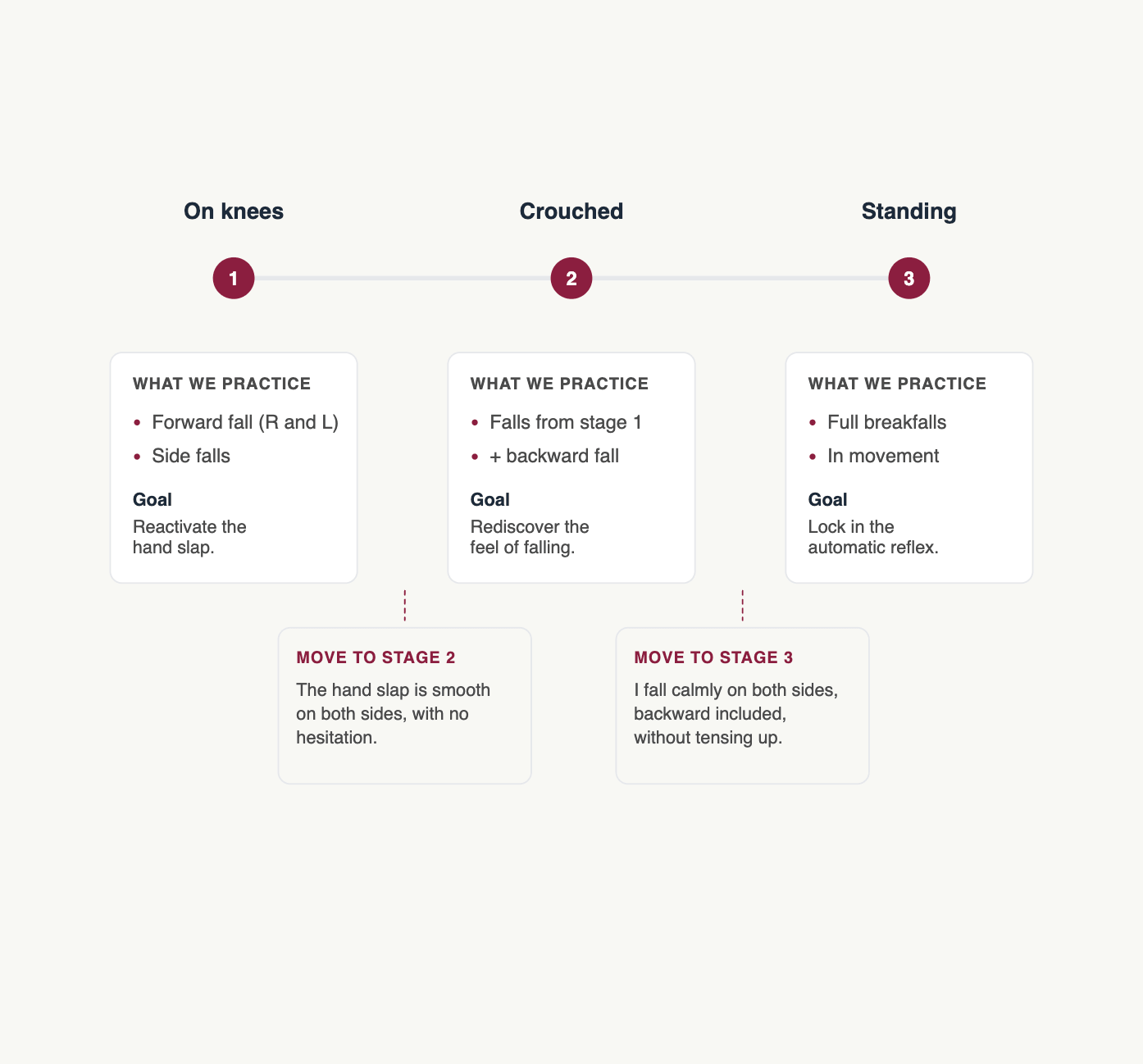
For those who really have hesitation, there’s a simple progression that removes the “height” factor at first. The idea is to start from the lowest point, where perceived risk is minimal, and gradually move up as automatic reflexes come back.
The first stage is on your knees on the tatami.
You work on the forward fall, right and left (Mae-mawari-ukemi), and the side falls (Yoko-ukemi). In this position, there’s no more fear linked to height, and you can run through repetitions without fatigue or stress.
The goal is to reactivate the hand slap.
Not spectacular, but incredibly effective for rebuilding the reflex.
The second stage is in the crouched position.
You redo the same falls as on your knees, and you add the backward fall (Ushiro-ukemi) which you couldn’t really practice before.
The height goes up a bit, the impact too, but you stay in a very manageable zone.
This is when you start to rediscover the feel of a “real” fall.
The third stage is the standing fall.
At this point, the body has already reintegrated the hand slap, so the extra height isn’t a major problem anymore.
You lock in the automatic reflexes, and then you can move on to ukemi in motion, then falls from real throws.
There’s no strict timing for moving from one stage to the next.
For some, one session is enough. For others, several weeks.
What matters is only moving up a notch when you genuinely feel at ease, not when you feel like you “should” be progressing.
For more on the method (working the right and left sides, specific drills for each stage, signals for when to move to the next), I cover all of that in the dedicated article: relearning breakfalls step by step: the on-knees, crouched, standing method.
The two rules for falling without getting hurt
The step-by-step progression is the frame.
But there are two technical rules you have to respect from the very first fall on your knees, and that never change afterwards, regardless of level.
Missing them means you can get hurt even if you’re doing everything else right.
The first rule: slap with the hand.
The principle is to disperse the impact energy into the hand and arm, rather than letting it travel through the whole body.
In practice, the hand has to hit the tatami firmly before the rest of the body touches the ground.
For the side fall, it’s the hand on the side of the fall that slaps. For the rolling forward fall, it’s the hand opposite the side of the roll. For the backward fall, it’s both hands at the same time, one on each side of the body.
A sharp slap, not soft, that’s where the difference between an absorbed fall and one that hurts lies.
The second rule, just as important and far more underrated: tuck the chin.
The idea is to prevent the head from hitting the ground at impact, especially on backward falls.
Tucking the chin toward the chest keeps the neck in a slight flex and keeps the head a few centimeters off the tatami.
Without that reflex, the head can snap back and hit the ground, which can go from headaches to neck strain to worse on a hard fall.
These two rules are non-negotiable.
The rest (fluidity, speed, beauty of the movement) comes with time and practice. Without these two fundamentals, there’s no safe fall.
Both rules apply together, from the very first fall.
For more on these two rules (biomechanics, common mistakes when coming back, edge cases like the weak side or throws where you’re holding the judogi), we break it all down in the 2 technical rules to fall safely in judo.
Sign up for the newsletter
One email a month with techniques, recovery tips and honest reflections for judoka returning after 40.
Warming up before falling
One thing that matters more at 40+ than at 15: the warm-up.
A cold body doesn’t forgive impacts, and a fall on a poorly prepared muscle or joint is the injury risk you could afford to ignore when you were younger.
The warm-up for ukemi works in two parts:
First, the cardio and muscular ramp-up (jogging, side steps, a few frog jumps) to raise body temperature and activate joints.
Then active stretching targeting the zones that will take the load: shoulders, biceps and triceps, neck, psoas, hips. These zones aren’t random, they’re the ones doing the work from the first fall, and a tight psoas on a backward fall is tension that spreads into the back.
Another thing to keep in mind: better to work on falls at the start of the session rather than at the end.
Technical quality drops with fatigue, and it’s precisely when you’re tired that you can do an ugly fall because you don’t have the energy to absorb cleanly.
For more on the ukemi-specific warm-up (detailed 10-minute routine, precise drills for each zone, when to stretch vs. when to activate), I cover all of that in the dedicated article: ukemi warm-up: how to prepare your body for falling at 40+.
In randori, accept the fall rather than endure it
There’s a counter-intuitive point I had to relearn at 40+: in randori, you sometimes need to favor the fall rather than resist at all costs.
The natural reflex when you feel yourself going is to tense up, extend your arms, plant a foot to block the throw.
Except that at our age, that calculation is rarely the right one.
When you resist a fully committed throw, the body absorbs the energy head-on instead of dispersing it in a clean fall.
The shoulder you brace to block is the shoulder that’s going to take the torque.
The arm you stiffen is the one that can end up hyperextended.
And the fall ends up happening anyway, just uglier.
In the end, there’s not much to gain by resisting, and a lot to lose.
Especially in training, where nobody’s really keeping score.
The ippon you “save” by tensing up has no value beyond a few seconds of ego satisfaction.
On the other hand, the sprain you can get from it lasts several weeks.
That doesn’t mean you should fall at the slightest pull. Judo is still a sport where you defend, where you move, where you break balance.
But when the throw is committed, when the point of no return has passed, it’s better to accept a clean fall than to tense up.
For more on this mental shift (the injury mechanics when you resist, when to accept, how an uke who can fall changes the dynamic with their partners), I cover all of that in the dedicated article: randori after 40: why you need to accept the fall rather than resist.
Rebuilding confidence in breakfalls, step by step
Ukemi aren’t a box to tick so you can move on to the “real” techniques.
They’re the base everything else rests on. Without solid breakfalls, randori are tense, techniques are limited, and the injury risk goes up.
With solid falls, everything becomes possible, including progressing at your own pace after 40.
For me, it took several sessions for the automatic reflexes to really come back.
A few weeks of work on each type of fall, and the reflexes returned without me needing to think about them.
From that point on, the randori get smoother, technique learning too, and confidence on the mat shifts completely.
And if the hesitation is really strong at the start, there’s no shame in talking to your sensei about it.
In most adult classes, 40+ are largely the majority, and nobody thinks it’s strange if a returning judoka spends a bit more time on falls than on the rest.
Further reading
- Why falling feels scary after 40 (and how to get past it) – the mindset and psychological angle
- Relearning breakfalls step by step: the on-knees, crouched, standing method – the practical progression guide
- The 2 technical rules for falling without getting hurt in judo – the mechanics of the slap
- Ukemi warm-up: how to prepare your body for falling at 40+ – the routine that reduces injury risk
- Randori after 40: why you need to accept the fall rather than resist – the mental shift
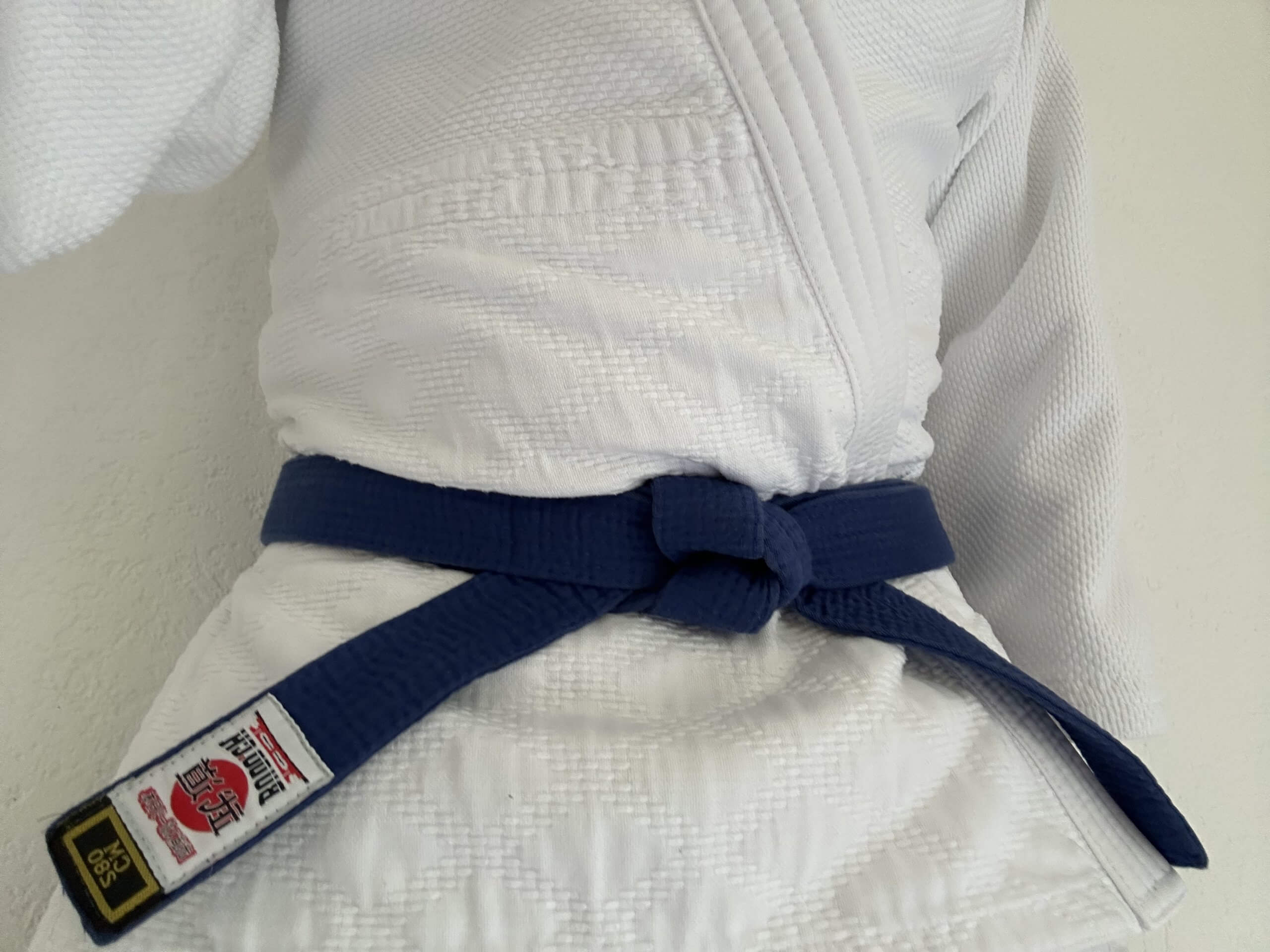
Trained in the 90s at the Judo Club Arlésien in the south of France, I got back into judo at 43 after a 27-year break.
Currently a blue belt, I train regularly with one clear goal: black belt before 50.
I’m not a sensei or a coach, just someone who’s been through the comeback and shares what he learns along the way.
RestartJudo is everything I wish I’d found when I stepped back on the tatami.
Sign up for the newsletter
One email a month with techniques, recovery tips and honest reflections for judoka returning after 40.