
There’s something I had to relearn when I came back to judo, and I didn’t see it coming: in randori, sometimes you need to let the throw happen rather than fight it.
In short:
It’s counterintuitive, especially if you used to compete, or just have the pride of someone who never liked taking ippon.
The natural reflex when you feel yourself going down: tense up, stretch out your arms, plant a foot to block the throw.
You tell yourself you’re going to get out of it.
Except at our age, that calculation is rarely the right one, and the price of getting it wrong isn’t what it used to be.
Why you resist (and why it’s wired into your body)
You didn’t invent this blocking reflex. It got conditioned over years, through hundreds of hours on the tatami where the goal was precisely not to land on your back.
If you competed when you were younger, it’s even more ingrained (every randori, every shiai, the same logic: resist, evade, recover).
Your body learned that before your brain even started thinking.
The problem is that this conditioning stays active, even after a long break of 15, 20 or 30 years.
You step back on the mat thinking you’re starting from zero, but your nervous system has kept that old script in memory: throw committed = I block.
That memory fires in milliseconds, well before your conscious thought.
Add to that pride, like it or not. Wearing your blue or brown belt at the club and getting thrown by a younger green belt stings. The blocking reflex is also an ego reflex, and the fear of falling in randori has the same root as the fear of falling in training.
What actually happens mechanically when you block
When you resist a properly committed throw, your body takes the full energy head-on instead of dispersing it into a clean fall.
Tori has set the kuzushi (off-balance), built the tsukuri (entry), and is finishing the throw with their weight and momentum.
The moment you stiffen up, you add your tension to theirs. The energy has to go somewhere, and it ends up exactly where you blocked.
Dr. Philippe Loriaut, an orthopaedic surgeon who treats judokas, lays it out clearly in this article (FR): poor falling technique is the most common cause of judo injuries. The mechanism is almost always the same: the judoka about to fall reaches out an arm to pivot and avoid landing on their back.
Result: the shoulder is the most frequently injured joint in judo, ahead of the knee and elbow.
Concretely, the classic injuries from blocking are:
- Acromioclavicular joint separation (the shoulder “popping”) on landing with a stretched arm
- Glenohumeral dislocation on a poorly controlled fall
- Elbow hyperextension when the arm goes back as a pivot to stop the fall
- ACL rupture on backward throws with the foot planted on the mat
And in every case, the fall happens anyway, just messier. (The technical rules for landing properly are here)
Sign up for the newsletter
One email a month with techniques, recovery tips and honest reflections for judoka returning after 40.
The math nobody does
In club randori, you “save” an ippon by blocking.
That ippon doesn’t count, nobody scores it, there’s no podium and no ranking.
Its only value: a few seconds of ego satisfaction. That’s what you gain. Now the potential cost.
Written out like that, it sounds obvious. On the mat, the moment you feel the throw coming, much less so.
The important nuance: accepting ≠ lying down
One thing to clarify. Accepting the throw doesn’t mean lying down at the first kumi-kata.
Judo is still a combat sport, where you defend, you move, you break your partner’s balance. Falling at the slightest touch is disrespectful to tori, who learns nothing from a partner who just lies down.
What you need to recognise is the point of no return. As long as you can evade, break the off-balance, get out of a grip, you’re doing your job as an active uke.
But once tori has set the kuzushi, entered, and your centre of gravity has crossed over their support point, it’s done.
The throw will happen.
At that exact moment, the question isn’t “fall or not”. The question is fall cleanly or fall badly.
With experience, that point gets easier to read. At the start, you’ll get it wrong both ways: sometimes lying down too early, sometimes blocking too late. That’s normal.
The fine-tuning happens over a lot of randoris.
A gift to your training partner
There’s another angle you understand better once you train in a club with adults. A good randori partner isn’t just someone who attacks well.
It’s also, and maybe most of all, someone who knows how to fall.
Picture the reverse. You attack a partner who you can tell is afraid of falling.
You hold back your throws, you don’t commit fully, you hesitate because you can see they’re going to block and you don’t want to hurt them. Your randori turns soft, you don’t really train your techniques, and they stay locked in their tension.
Nobody progresses.
The opposite: a partner who accepts and falls cleanly is a gift.
You can commit fully, try things, fine-tune your timing. And by falling, they train their ukemi under real conditions. Both of you progress.
That’s the spirit of randori as Kano envisioned it:
“An exchange where each person allows the other to get better.”
Past 40, in a club where you’re going to see the same partners year after year, that’s the difference between a dojo where everyone trains seriously and a dojo where everyone half-protects themselves.
Rewriting the script is what lets you keep going
Reprogramming this reflex takes time. It doesn’t get fixed in one session, or one month.
It’s foundational work, randori after randori, accepting a few “free” throws early on to rebuild trust in your ukemi and your reading of the point of no return.
But that’s exactly the work that lets you still train ten years from now, instead of stopping at the first big injury. At our age, judo isn’t about points anymore, it’s about lasting. And lasting gets built by protecting your joints, respecting your partners, and accepting that the fall is part of the game.
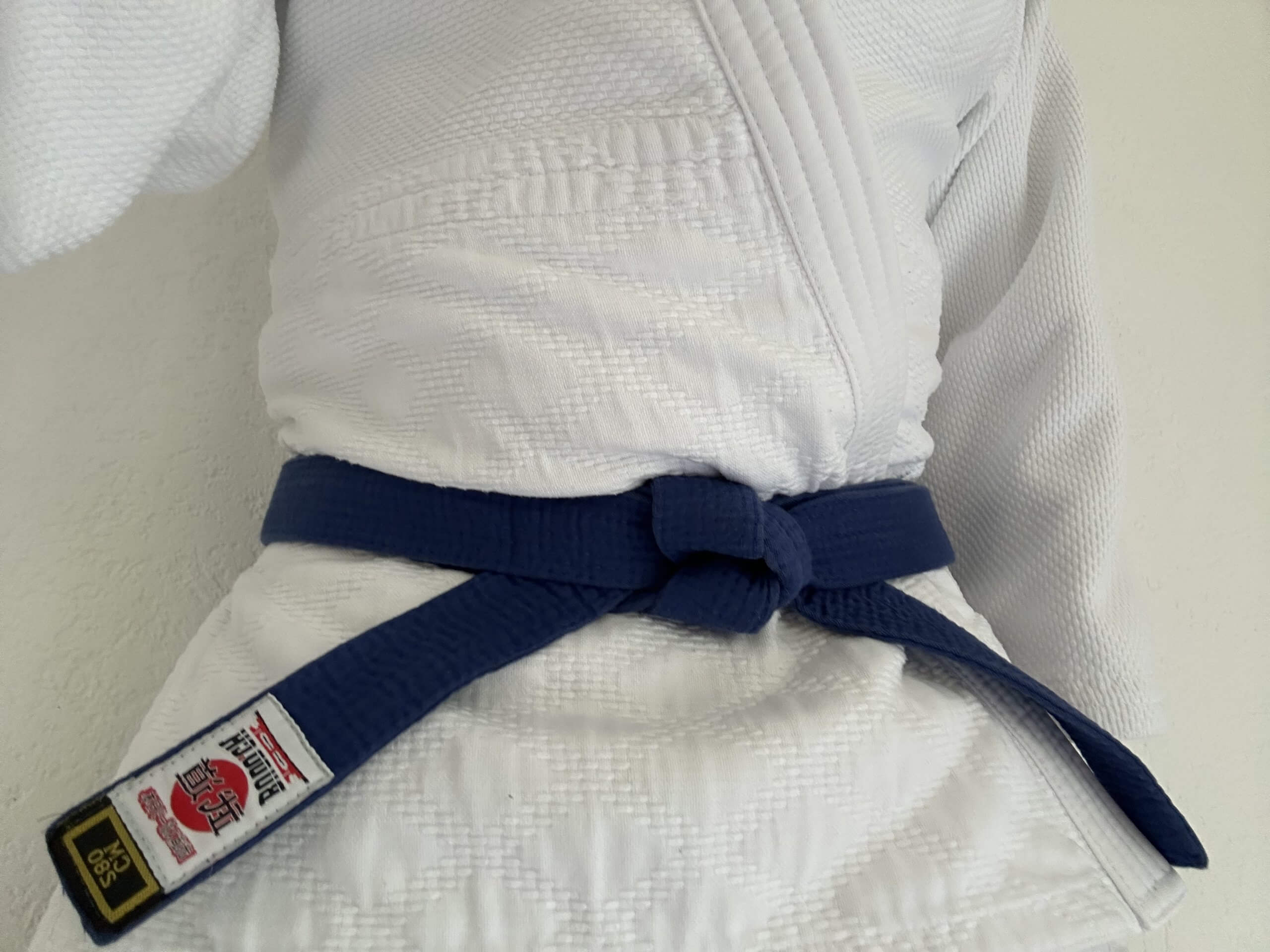
Trained in the 90s at the Judo Club Arlésien in the south of France, I got back into judo at 43 after a 27-year break.
Currently a blue belt, I train regularly with one clear goal: black belt before 50.
I’m not a sensei or a coach, just someone who’s been through the comeback and shares what he learns along the way.
RestartJudo is everything I wish I’d found when I stepped back on the tatami.
Related articles:
- Why falling feels scary after 40 (and how to get past it) – the mindset and psychological angle
- Relearning breakfalls step by step: the on-knees, crouched, standing method – the practical progression guide
- The 2 technical rules for falling without getting hurt in judo – the mechanics of the slap
- Ukemi warm-up: how to prepare your body for falling at 40+ – the routine that reduces injury risk
Sign up for the newsletter
One email a month with techniques, recovery tips and honest reflections for judoka returning after 40.