
A few weeks ago I was watching a guy at my club learning to fall for the first time at 45, and it was telling.
He’d try a forward fall, place his hand correctly, but instead of rolling over a single shoulder to spread the impact, he’d end up tumbling over both shoulders in a kind of somersault that didn’t look much like a judo fall anymore.
On every attempt, you could clearly see his body hesitate at the moment of letting go, as if something in him was resisting the very idea of falling on purpose.
The short version:
It’s a scene you might have already seen, or lived yourself, if you came back to judo after 40.
Falling stays something impressive, and for anyone who hasn’t practiced it young, throwing yourself forward and trusting the mat to absorb the impact takes something the adult body has often lost along the way.
For those who already fell when they were young, the reflexes do come back with a bit of practice (which is exactly what relearning to fall safely is about), whereas for the others, the apprehension is well rooted and won’t disappear in one class, or even several.
This fear has a fairly clear explanation, and more to the point, it can be worked on, but you have to understand where it comes from first.
Back in the day, we fell without thinking about it
When I was younger, we learned to fall at every training session, and it was a full part of the warm-up.
We did countless falls in all sorts of situations, sometimes even over the height of a bench, or over two or three people lying on the mat.
“Nobody really asked themselves whether it was dangerous. We just did it because that’s how it was.”
And so the body recorded the information “falling is normal” long before the head had time to build anything around it.
Past 40, it’s exactly the opposite.
The head shows up first, with all its calculations, memories and anticipations, and the body follows (or doesn’t). And that’s precisely where the apprehension settles in, sometimes quietly, sometimes a lot less so.
Why the adult brain resists falling on purpose
My current sensei gave me an explanation that holds up well.
The earlier you learn, the earlier the reflexes settle in, and crucially, the less apprehension you build around the act of falling.
That lines up with what you see in most sports where falling is part of the game.
In alpine skiing or ice skating for instance, falls are common from the very first lessons, and kids go for it without really thinking about it.
The body records the information “falling is normal” before the head has had time to build any fear around it.
The brain has spent 20 or 30 years recording a very clear logic:
- don’t slip on the stairs
- don’t fall on black ice
- don’t hit a pole on your bike
- don’t go down running for a bus
- keep your footing on skis when the terrain gets tricky
- stay balanced when carrying groceries or a kid
And so falling has become a problem in the adult mind, possibly a serious problem, with sick leave and a medical bill to go with it.
So when you walk onto a tatami and that same brain is asked to let itself fall on purpose, there’s bound to be a conflict.
Height can be one reason, body weight another, and the memory of injuries from daily life (or the ones seen in others) plays its part too.
Sign up for the newsletter
One email a month with techniques, recovery tips and honest reflections for judoka returning after 40.
The trap: resisting is what gets you hurt
And that’s exactly where the real risk is.
If you’re afraid of falling and you resist the throw, that’s where you get hurt, not the other way around.
My first sensei used to repeat it to me often.
“Before you even think about winning, you’ve got to learn how to fall.”
The logic is fairly simple, when you actually think about it.
That’s pure mechanics, not judo mysticism.
And it’s also why the two technical rules of cushioning are what you need to understand before anything else, because they turn the fall into absorption rather than collision.
The good news for former practitioners
The good news in all this is that for those who already fell when they were younger, the reflexes come back fairly quickly, with some consistent work.
You don’t start from zero, even after 27 years off. Muscle memory is a massively underrated resource: it’s there, just dormant, and it’s a matter of waking it up with the right method.
To give you a concrete reference point, my own click happened during a randori, against a brown belt.
A really nice tai-otoshi, perfectly committed, the kind of throw that doesn’t forgive and you don’t see coming.
And instead of resisting, the way I might have a few weeks earlier, I fell cleanly, with a solid cushion at impact, in proper timing.
It was that exact moment when those watching from the side of the mat stop chatting, locked in on the action, in admiration of the throw as much as the fall, because everything happened exactly the way it was supposed to.
A clean throw, a clean fall, a deserved win for my “opponent”. And on my side, the very clear feeling that my body had got the hang of it again, without my head needing to step in.
Where to go from here
Fear of falling after 40 isn’t a weakness, and it’s not a sign you’re no longer cut out for judo.
It’s a logical reaction from a brain that has spent decades avoiding what it’s now being asked to do on purpose.
The real question isn’t to stop being afraid, because that can take time, and that’s fine.
The real question is to learn to fall properly, so that fear has no reason to lock you up anymore, and therefore no power left to get you hurt.
For that, there’s a progressive method in three steps that lets you rebuild the reflexes starting from the ground, and that’s exactly what’s covered in the guide on the knees, crouch, standing progression.
Trained in the 90s at the Judo Club Arlésien in the south of France, I got back into judo at 43 after a 27-year break.
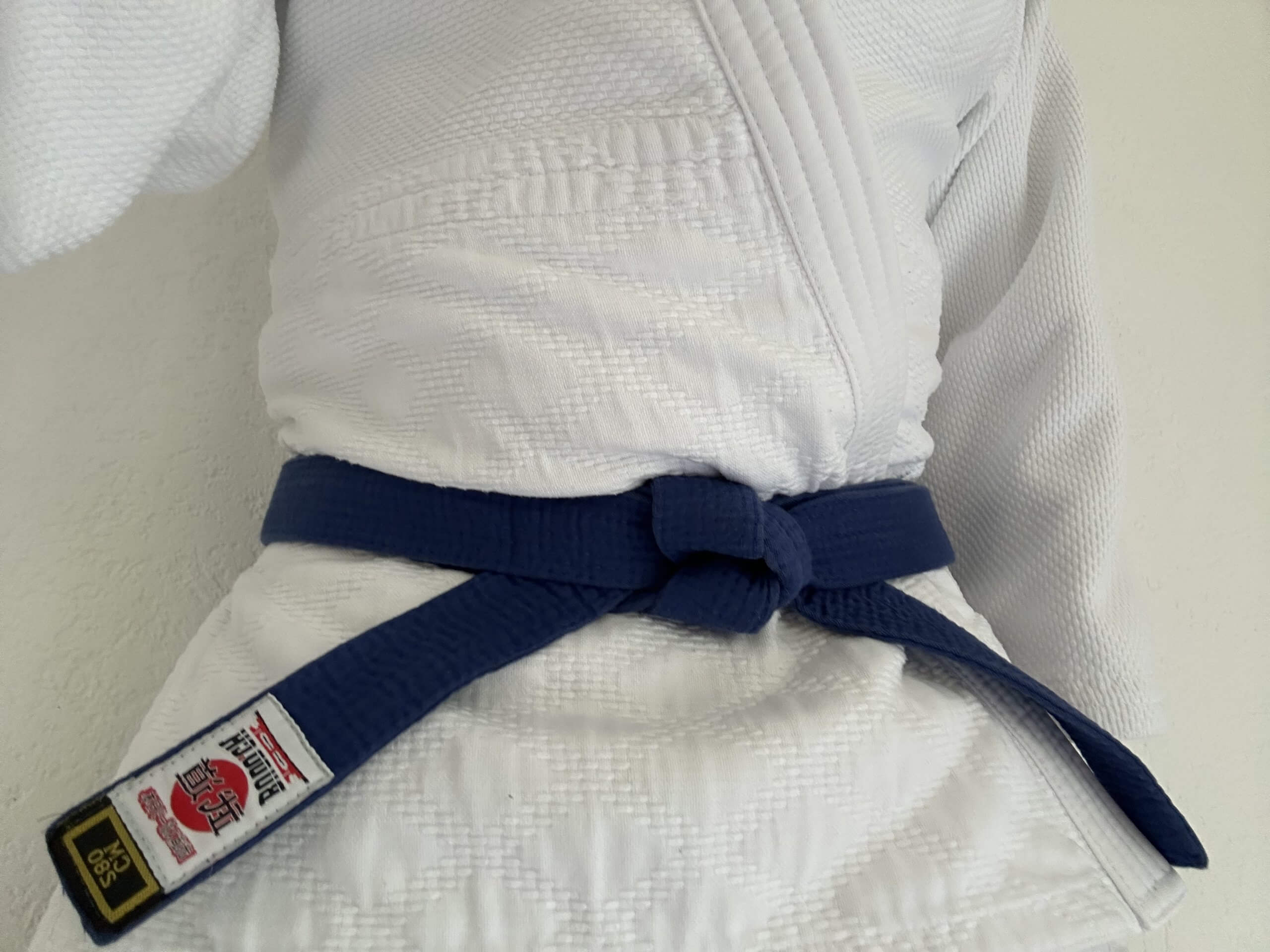
Currently a blue belt, I train regularly with one clear goal: black belt before 50.
I’m not a sensei or a coach, just someone who’s been through the comeback and shares what he learns along the way.
RestartJudo is everything I wish I’d found when I stepped back on the tatami.
Related articles:
- Relearning breakfalls step by step: the on-knees, crouched, standing method – the practical progression guide
- The 2 technical rules for falling without getting hurt in judo – the mechanics of the slap
- Ukemi warm-up: how to prepare your body for falling at 40+ – the routine that reduces injury risk
- Randori after 40: why you need to accept the fall rather than resist – the mental shift
Sign up for the newsletter
One email a month with techniques, recovery tips and honest reflections for judoka returning after 40.