
The sensei announces “we’re doing breakfalls” at the start of class, and you can already feel your body tightening up.
You know you used to know, but you’d rather not have your first fall after 20 years be the one that proves you don’t anymore.
Between trusting reflexes that have been asleep for decades and just going for it standing up, there’s a middle ground: lower the bar, then bring it back up as the automatisms return.
In the guide on ukemi after 40, we covered why falls are the absolute priority when coming back. In the article on the 2 technical rules, we saw how the hand and chin make all the difference on impact absorption.
This article is the link between the two: the method to rebuild the automatisms without putting yourself at risk.
In short:
Why a progression rather than going straight to standing
The principle is simple: take the “height” parameter out of the equation at first.
When you fall standing, your body starts higher, the impact is harder, and if the technique isn’t back yet, that’s where you tense up or take a hit that costs you three days of soreness.
Starting from the ground up, you work the impact absorption (the hand slapping flat, the chin tucked) without the fall itself being an event.
That said, this isn’t a universal method or an obligation.
Some returnees find the standing sensations again from the very first session and won’t need every stage.
Others need every single stage to rebuild confidence.
Both are valid. The progression serves those who need it, that’s all. The right entry point is the one where you feel comfortable, not the one a manual prescribes.
From safety on the ground to ease standing up.
Stage 1: judo falls from kneeling
You start kneeling on the tatami.
In this position, you can work the right forward fall, the left forward fall, and the side falls (mae-ukemi and yoko-ukemi) without height being a problem.
The goal isn’t to simulate a real throw, it’s to reactivate the impact absorption movement: how the hand slaps the tatami, how the body aligns, how the impact is handled.
You can do plenty of these, without fatigue or stress, and that’s exactly what you need to rebuild the reflex.
The first sessions, you can spend several minutes just on this. Not spectacular, but incredibly effective at getting the right movements back online. And since you’re flat on the ground, even if the technique isn’t perfect, not much can happen.
This is the stage favored by returnees who have real apprehension about falling.
In my club, I’ve seen several returnees go through this stage because the fear of falling was stronger for them. When apprehension takes over, starting as low as possible is what unblocks the situation and lets you find confidence again before going higher.
Stage 2: judo falls from a squat
Once the kneeling falls feel comfortable, you move to a squatting position.
You redo the same ones (right and left forward fall, side fall), and you add the back fall (ushiro-ukemi) which you couldn’t really work on from kneeling. The height goes up a little, the impact too, but you stay in a very manageable zone.
This is where you start to feel the sensation of a “real” fall again, with the body tipping over and having to absorb the impact.
It’s also where you can really check that the automatisms are in place on both sides. There’s always one side you favor more than the other, and if a side still doesn’t work, you spend more time there before moving up.
For my part, I started directly at this stage at the very first training.
No judogi, in joggers and a technical t-shirt I’d bought the day before at Decathlon, I went straight into the side falls at full height, and the leg placement came back almost automatically.
The synchronization between the fall and the hand’s impact absorption: instant.
Going onto your side, tucking the chin, slapping the mat firmly… no real problem.
For the forward falls I had a slight apprehension, and the idea of doing them from a squat appealed to me. So squatting was the right compromise for me: not flat on the ground, not at full height.
It’s only after fully mastering this stage that I moved on to standing falls.
Stage 3: standing falls in judo
When you’re at ease squatting, you stand up and start falling from standing.
These are the “classic” ukemi you find in every training session.
At this point, the body has already reintegrated the impact absorption movement, so the extra height isn’t a major problem anymore.
You finalize the automatisms, and you can then move on to ukemi in motion, in a roll, then to falls from real throws.
There’s no strict timing for moving from one stage to the next. For some, it’ll be one or two sessions per stage. For others, several weeks.
What matters is only moving up when you really feel comfortable, not when you have the impression you “have to” move up because others are.
No one’s timing you, and it’s your body that decides the pace.
The extra mat: the bonus tool
A variation my sensei uses regularly: adding a soft mat over the tatami during fall sequences.
It cushions a lot more, and it changes everything for two specific uses.
The first one is for people who lack automatisms and are afraid of getting hurt.
The mat completely unblocks the situation. You can chain forward falls (the most spectacular and often the most feared) without taking a hard hit. The body gets going again without fear taking over, and it’s that absence of pain that lets you repeat calmly.
The second is for working the weak side.
A left forward fall when you’ve always worked on the right is typically when the technique falters. With the extra mat, you can afford some placement errors without the tatami “correcting” you with an unpleasant impact. You retrain the weak side under safe conditions, and you go back to the regular tatami once the technique is back.
How long until your falls are fluid again?
To give you a concrete benchmark: it took me 4 to 5 weeks for the falls to become automatic again to the point I could chain them without thinking.
At one or two trainings a week, with ukemi systematically integrated into the warm-up.
And that’s still the case today, whether it’s a technical training or a team training: falls stay in the warm-up, because that’s what keeps the reflex sharp long-term.
Past 40, the principle is to accept you’re not 20 anymore, and that everything takes longer.
Especially when it comes to reinstalling automatisms that have been asleep for 20 or 30 years.
Four to five weeks is short on the scale of a comeback project, but it’s longer than what it takes to remember it intellectually.
Making peace with that gap between the head that remembers and the body that has to rebuild is an important part of the path.
Going further
The method is deliberately simple: you start as low as possible, you go up at your body’s pace, and you end up standing when the automatisms are back. If you’re comfortable from the start, you can skip stages. If the apprehension is there, you take your time.
No one’s watching, and that’s exactly how it should be.
Once the progression is done, the work on falls doesn’t stop. Ukemi stay in the warm-up at every session, because that’s what keeps the reflex sharp long-term.
Going further:
- The 2 technical rules that apply at every stage of the progression: the hand that absorbs, the chin tucked.
- The pillar guide on ukemi after 40 for the overview.
- Detailed technique sheets by fall type: mae-mawari-ukemi (forward fall), yoko-ukemi (side fall), ushiro-ukemi (back fall).
Trained in the 90s at the Judo Club Arlésien in the south of France, I got back into judo at 43 after a 27-year break.
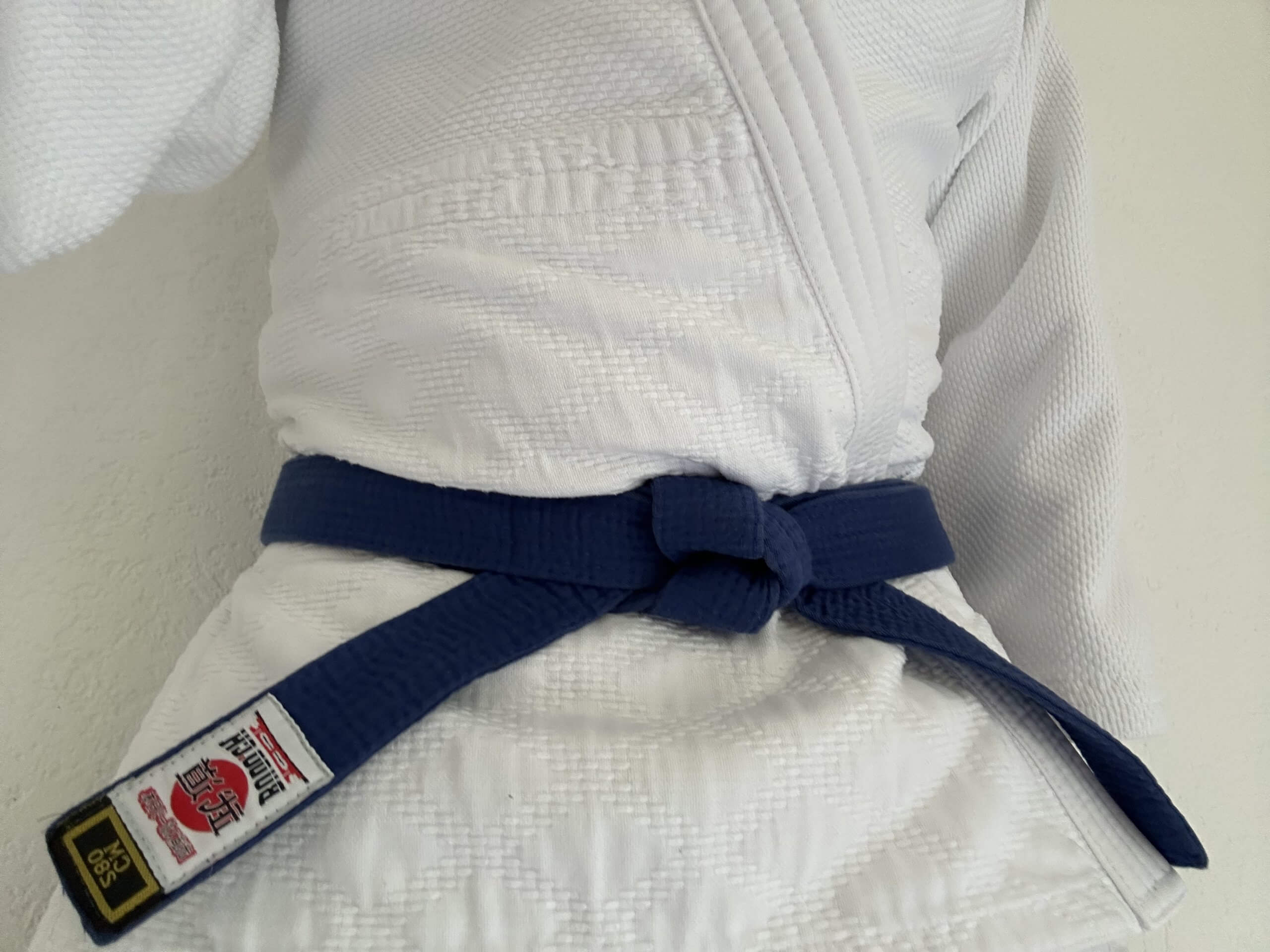
Currently a blue belt, I train regularly with one clear goal: black belt before 50.
I’m not a sensei or a coach, just someone who’s been through the comeback and shares what he learns along the way.
RestartJudo is everything I wish I’d found when I stepped back on the tatami.
Related articles:
- Why falling feels scary after 40 (and how to get past it) – the mindset and psychological angle
- The 2 technical rules for falling without getting hurt in judo – the mechanics of the slap
- Ukemi warm-up: how to prepare your body for falling at 40+ – the routine that reduces injury risk
- Randori after 40: why you need to accept the fall rather than resist – the mental shift