
In the pillar guide on ukemi after 40, we saw that breakfalls are the absolute priority when coming back to judo, and that there’s a three-step progressive method to relearn them without forcing it.
But the progression is the frame.
Within that frame, there are two technical rules that apply to every fall, no matter the type, no matter the level.
They’re what makes the difference between a fall that disperses the impact and a fall that concentrates it where it shouldn’t go.
In short:
Tuck the chin, slap with the hand: that’s it.
But that’s everything, and that’s not nothing.
A 2022 biomechanical review in the journal Sports confirmed, through 3D kinematic analysis, that properly executed ukemi keeps impact values below the injury threshold.
Beyond the properly executed art of falling, there’s a real, concrete benefit: the body takes less, the head is protected, and reflexes become allies instead of risks.
In this article, we break down these two rules, why they’re critical after 40, the common mistakes when coming back, and how to reinstall them when some have faded during the years off.
Rule 1: slap with the hand
The basic principle is to disperse the impact energy into the hand and arm, rather than letting it travel through the whole body.
In practice, the hand hits the tatami firmly the moment the body touches the ground, sometimes even a split second before.
The palm, not the fingers, not the forearm. It’s a point you can forget when coming back.
The impact zone is the flat palm, fingers together.
If you slap with the edge of the hand or the fingers, the absorption no longer happens properly, and on top of that you risk hurting your wrist or elbow.
The arm stays slightly open, at about 45 degrees from the body, neither glued to the torso nor locked out straight. The idea is for the elbow to stay clear, not pinned to the ground.
Which hand slaps depends on the type of fall.
- For the side fall (Yoko-ukemi), the hand on the side of the fall slaps (falling right, right arm).
- For the rolling forward fall (Mae-mawari-ukemi), it’s the hand opposite the side of the roll (rolling over the right shoulder, left hand slaps).
- For the backward fall (Ushiro-ukemi), both hands slap at the same time, one on each side of the body.
Sign up for the newsletter
One email a month with techniques, recovery tips and honest reflections for judoka returning after 40.
Timing and the slap
My sensei, back when I was young, used to repeat a line I’ve never forgotten: « the harder you slap, the less you feel the fall ».
Looking back, I’d nuance that a bit.
It’s not really raw force that absorbs, it’s the sharp, firm slap at the right moment:
- A soft slap, even a powerful one, doesn’t absorb well.
- A sharp slap, even less forceful, forces proper arm placement and the right muscle tension right at impact.
Slapping hard for the sake of slapping hard, that’s more like the best way to hurt your hand.
The hand slap is the move that comes back the fastest when returning, because it’s the one you repeated the most in the early years.
In my case, from the very first session, it just happened. A déjà-vu, the hand slapping at the right moment without me having to think about it.
That’s reassuring, but it can also be misleading: an automatic move can get sloppy without you noticing.
Hence the value of going back to the basics on your knees from time to time, where you really feel whether the palm slaps clean or not.
Rule 2: tuck the chin
Second rule, just as important, and largely more underrated: tucking the chin.
The idea is to keep the head from hitting the ground hard at impact, especially on backward falls. Tucking the chin toward the chest keeps the head a few centimeters off the tatami, even when the back touches.
On the backward fall, it’s non-negotiable.
Without a tucked chin, the head inevitably snaps back and hits the tatami.
Even on a soft mat, that’s a hit that hurts, that can trigger headaches or tension at the base of the skull, or worse on a hard fall.
It’s the move that protects one of the most fragile parts of the body.
On side and forward falls, the risk is lower, but the tucked chin still matters.
On the rolling forward fall in particular, tucking the chin actually initiates the roll.
The gaze going down pulls the head, which pulls the shoulders, which pulls the rotation. Without a tucked chin, you break the flow of the movement.
The trick of looking at your feet
Where the hand slap came back on its own when I returned, the tucked chin, I had more or less forgotten.
And I’m not the only one: it’s a reflex that fades easily, because it’s less « visible » than the slapping hand.
You don’t get called out on it as often, you get through a few sessions, and one day you hurt yourself.
The trick that helped me reinstall the reflex is a classic cue that’s easy to forget: look at your feet or your belt knot, and the chin tucks automatically, without you having to think about it.
It keeps you from tensing the whole neck, and the move stays natural. A simple cue, but it does the job.
In the first weeks of coming back, you have to think about it on every fall, at least during the warm-up.
After a few weeks, it becomes automatic again. But until it is, you think about it.
The specific traps when coming back
The two rules are simple on paper. But there are a few situations where they become harder to apply, especially when returning.
The weak side
When you practiced young, you built automatic reflexes on one side.
For most judoka, that’s the right side, because that’s how we’re taught by default.
I’m left-handed myself, but since I practiced for years working everything on the right side (like almost everyone at the club), today I’m less comfortable on falls to the left. The ones that require slapping with the right hand.
It’s the same logic as left-handed guitarists learning on a right-handed guitar, or left-handers using the mouse on the right.
You adapt, and in the end it’s even an advantage for working tori and uke on the same side. But on the falls, it means one side where the move is clean and one side where you have to think more.
The tip: rework the weak side first during the warm-up, even when it’s less comfortable. That’s where the automatic reflexes are the most fragile, and where you can get hurt if the fall comes fast.
Falling during a throw
Another point that complicates things: during an actual throw, uke (the one being thrown) often holds onto tori’s judogi, at the lapel or sleeve. As a result, the hand that should slap is busy holding the kimono.
The natural reflex is to hold onto the judogi with both hands out of fear of the impact. That’s exactly the wrong reflex. The more you hold on, the less you absorb, and the more the shock travels through the body.
The automatic reflex to build is letting go in time and slapping the tatami. A well-absorbed fall protects you more than a hand clenched on a lapel.
It’s one of the points that takes the most practice when coming back, because it goes against instinct. But once the reflex is back, throws become much calmer to take.
Two rules, not one more
Slap with the hand, tuck the chin.
Those are the two fundamentals. The rest (fluidity, speed, beauty of the move) comes with time and repetition.
But without these two rules, there’s no safe fall, no matter the level, no matter the age.
- The slapping hand disperses the shock.
- The tucked chin protects the head.
One without the other isn’t enough.
Both together, applied from the very first fall on your knees to the last fall standing, that’s what makes the difference between a judoka who stays in it for the long haul and one who drops out at the first injury.
In practice, these two rules apply to every stage of the 3-step progressive method: on knees, crouched, then standing.
And if the hesitation around falling stays strong despite technical mastery, there’s often something else at play.
Trained in the 90s at the Judo Club Arlésien in the south of France, I got back into judo at 43 after a 27-year break.
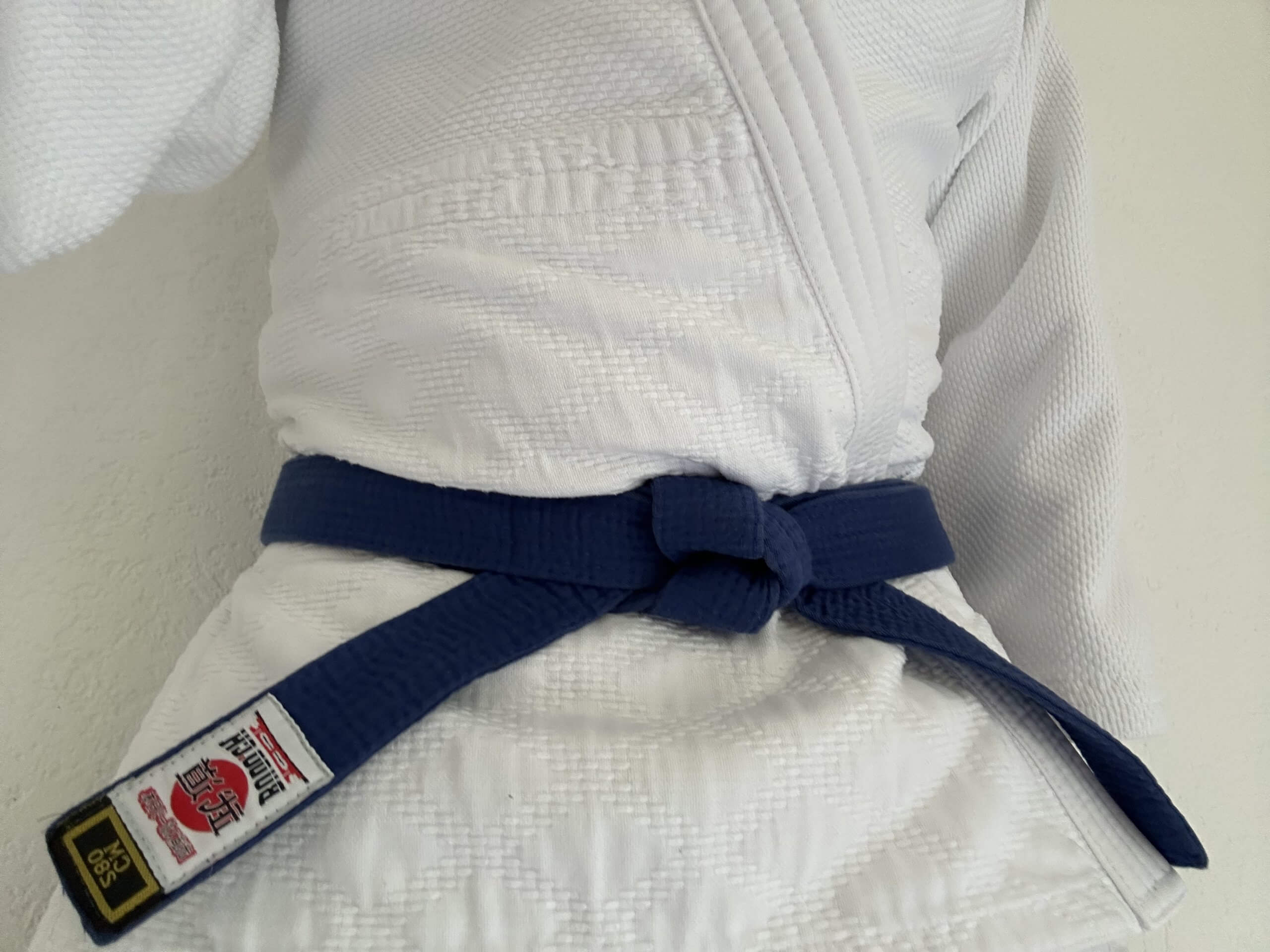
Currently a blue belt, I train regularly with one clear goal: black belt before 50.
I’m not a sensei or a coach, just someone who’s been through the comeback and shares what he learns along the way.
RestartJudo is everything I wish I’d found when I stepped back on the tatami.
Related articles:
- Why falling feels scary after 40 (and how to get past it) – the mindset and psychological angle
- Relearning breakfalls step by step: the on-knees, crouched, standing method – the practical progression guide
- Ukemi warm-up: how to prepare your body for falling at 40+ – the routine that reduces injury risk
- Randori after 40: why you need to accept the fall rather than resist – the mental shift
Sign up for the newsletter
One email a month with techniques, recovery tips and honest reflections for judoka returning after 40.